At some point, the screen stops being enough. You've made images you believe in, printed them, studied them under daylight and tungsten. You know they work. And the question forms: what would it mean to put these on a wall, in a room, and invite strangers to stand in front of them?
I rarely exhibit my own work, but I've spent years helping younger photographers prepare their first shows. What follows comes from watching that process dozens of times and solving the problems that come up. Some of these problems are creative. Most of them are logistical. Almost all of them are solvable if you plan early enough.
Finding a Venue
The perfect venue doesn't exist. Stop looking for it. Look for a space that's good enough, available, and within your budget.
In 2022, I helped a young photographer from Marseille prepare her first solo show. She'd spent months agonizing over finding the ideal gallery in Paris. When she finally accepted a modest project room on a side street in the Marais, the show came together in six weeks and every print sold. The lesson: the venue matters far less than the work and the commitment to getting it on the wall.
Traditional galleries fall into two categories: commercial galleries that take a commission (typically 40-50%) on sales and handle promotion, and project spaces or kunsthalle-type venues that charge a rental fee and leave everything to you. Research thoroughly before approaching either. Visit the gallery, study their programme, understand their aesthetic. A gallery showing conceptual installation art won't want your B&W landscape series. When you approach, be professional: brief email, coherent artist statement, ten to fifteen strong images as a PDF portfolio or website link, and a clear proposal with dates and practical details.
Alternative spaces are often better for a first show than traditional galleries. Cafes, bookshops, co-working spaces, hotel lobbies, wine bars. Often free wall space because your art improves their environment. You handle everything yourself, but the barrier to entry is a conversation with the owner rather than a curatorial committee. My first exhibition was in a jazz bar in Oberkampf. Terrible lighting, variable humidity, and the prints had to compete with the liquor shelf. But fifty people came, three prints sold, and I learned more in that one evening than in the previous year of printing alone in my studio.
Festivals and open calls are worth the application fees. Events like Les Rencontres d'Arles, Unseen Amsterdam, and Format Derby actively seek new voices. The application process forces you to write a coherent artist statement and sequence your work with intention, which is valuable even if you don't get accepted. Photo festivals also offer fringe events and off-site exhibitions where emerging photographers can show alongside the main programme at lower cost.
Venue Negotiation
Get everything in writing. A handshake agreement about dates, wall space, and costs will cause problems. Draft a simple agreement covering: exhibition dates (including installation and de-installation days), rental fee if any, commission percentage on sales, what the venue provides (hanging system, lighting, insurance, invitations), what you provide (prints, frames, labels, refreshments), cancellation terms, and liability for damage.
Ask specifically about the hanging system. Professional galleries have picture rail or track systems that let you adjust height without drilling. Many alternative spaces have bare walls and expect you to bring your own hardware. A few phone calls to local galleries will tell you what hanging systems are standard in your area. In Paris, most smaller galleries use STAS picture rail with steel cables and hooks. In many alternative spaces, they still rely on direct wall mounting with screws and rawlplugs, which means you'll need a drill, a level, and someone who can patch holes when you de-install.

Curating Your Body of Work
A strong exhibition works as a coherent body. Ten to twenty images for a typical solo show. Fewer than ten feels sparse unless the prints are very large. More than twenty risks overwhelming the viewer and diluting your strongest work.
Ask three questions of each photograph: Does it belong thematically? Will it hold up at exhibition scale? Does it contribute something no other image in the selection provides? If any answer is no, cut it. You'll always have more candidates than slots, and the hardest part of curation is removing images you love but that don't serve the series.
Get outside eyes on your selection. Show the work to two or three people whose visual judgment you trust. Not family, not your partner, not anyone who'll tell you everything is wonderful. You need someone who'll say "this one is weaker than the others" or "these three images are redundant." I've seen first-time exhibitors include twenty-five images when fifteen would have been stronger, because nobody told them to edit harder.
Once you have your final selection, sequence it. Think about rhythm: quiet and loud, scale and density, opening statement and closing note. Walk the sequence physically if you can. Pin prints to a wall and move along them as a viewer would. Notice where your eye lingers and where it skips. Adjust until the order feels inevitable. The opening image sets the tone. The closing image is what the viewer carries out the door. Those two slots deserve extra thought.
Insurance and Transport
Insurance is the thing nobody thinks about until something goes wrong. A framed 60x80 cm print on Photo Rag Baryta behind Museum Glass, in a Nielsen aluminium frame, costs 200-400 EUR to produce. Fifteen of them is 3,000-6,000 EUR of physical inventory. If a pipe bursts in the gallery overnight, or a visitor knocks a print off the wall, who pays?
Ask the venue about their insurance policy. Many galleries carry "nail to nail" coverage, meaning the work is insured from the moment it's hung to the moment it's taken down. Some venues extend coverage to include transport to and from the gallery. Others cover nothing and expect you to arrange your own policy. A short-term exhibition insurance policy through a specialist insurer (Hiscox, AXA Art, or a local equivalent) typically runs 1-3% of the total insured value for a one-month exhibition. For a 5,000 EUR show, that's 50-150 EUR. Cheap peace of mind.
Transport is the other logistical headache. Framed prints are fragile and bulky. For local shows, I transport in my car with blankets between each frame and foam padding against the doors. For anything shipped, I build plywood crates or use Strongbox cardboard art shippers (available from conservation suppliers). Each frame gets a glassine interleaf over the glazing, corner protectors on all four corners, and foam spacers between frames. Label every box with "FRAGILE" and "THIS SIDE UP" and assume the courier will ignore both labels entirely.
Timeline and Budget
Six months out: Secure the venue. Confirm dates and what's provided (hanging system, lighting, insurance). Finalize image selection. Commission any printing you can't do yourself. Six months sounds like a long time, but professional framers often have 8-12 week lead times, and you'll want finished, framed prints in hand at least a month before the opening for final inspection and any reprints.
Four months out: Order frames and matting. Allow eight to twelve weeks if using a professional framer. Write your artist statement. This is harder than it sounds. Keep it under 300 words, written in first person, describing what the work is about and why you made it. Avoid art-world jargon. Design your invitation card, both digital and physical if your budget allows.
Two months out: All prints complete and framed. Begin promotion: social media, email invitations to your personal network, local press, photography blogs, event listings. Send personalized invitations to photographers, curators, and gallery owners whose attention you'd value. A real invitation, not a mass email. If there's a local photography magazine or blog, pitch them a preview story.
Two weeks out: Measure walls, create a scale diagram (graph paper works, or use a tool like Canva or Keynote with rectangles to scale), know exactly where each piece goes before you arrive with a drill. Prepare labels (artist name, title, year, edition number, medium, dimensions, price if selling), artist statement boards, price list, guest book, red dot stickers for sold works.
Installation day: Arrive early. Bring more tools than you think you need: drill, level, tape measure, pencil, hammer, picture hooks (backup for the hanging system), blue painter's tape for marking positions, step ladder, cleaning cloth for glass, white cotton gloves. Hang slowly. Step back constantly. Have someone stand where viewers will stand and look at each print from their perspective, not yours. Allow a full day for a fifteen-piece show.
Estimated Budget for a 15-Print Solo Exhibition (EUR):
Fine art printing (outsourced, A2-A1 on Photo Rag Baryta or equivalent): 300 - 600 | Conservation matting (8-ply, custom cut): 150 - 350 | Framing (Nielsen aluminium, Museum Glass): 800 - 2,000 | Venue hire (if applicable): 0 - 1,500 | Promotion (invitation cards, postage, online ads): 100 - 300 | Vernissage catering (wine, refreshments, 40-60 guests): 150 - 400 | Insurance (if not venue-covered): 100 - 300 | Labels, artist statement panels, print materials: 50 - 120 | Transport (fuel, packing materials, possibly courier): 50 - 200 | Miscellaneous (hanging hardware, cleaning supplies, contingency): 100 - 200 | Total: 1,800 - 5,970
The largest variable is framing. Consider unframed alternatives (aluminium Dibond mounting with hidden rail, acrylic face-mounting, wire clip systems) if budget is tight. A Dibond-mounted show can cut framing costs by 50-60%.
Hanging and Lighting
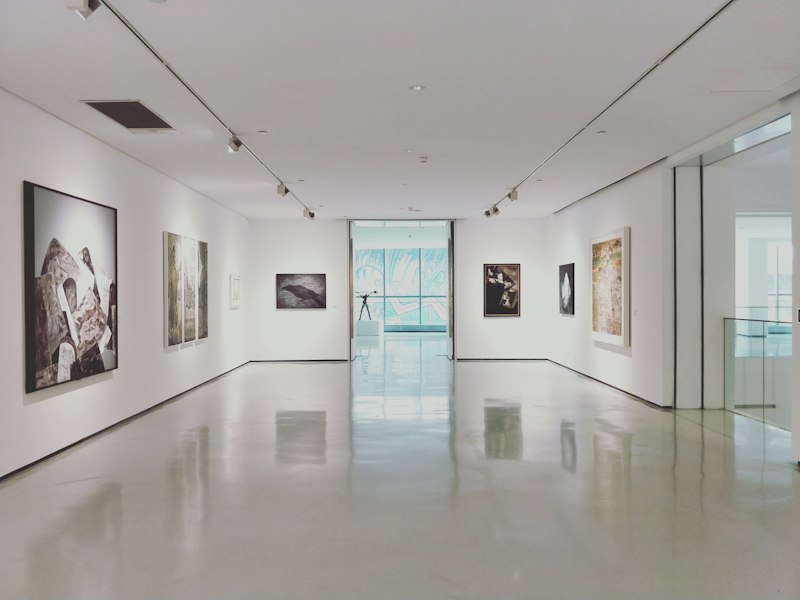
Center of each artwork at 145 to 150 cm from the floor. Spacing between works: 15-20 cm minimum for medium pieces, 25-40 cm for anything over 80 cm on the long edge. Don't crowd the walls. White space lets each image breathe. I've watched first-time exhibitors try to fill every available centimeter of wall, and it always weakens the show.
Track lighting at 30 degrees from vertical, aimed at print center. If the venue lacks dedicated art lighting, supplementary LED track lighting can be rented. In Paris, I use a company called LightPro that rents Erco and iGuzzini track systems for about 15-25 EUR per fixture per week, including installation. Similar rental companies exist in most European cities. Ask the venue or other local photographers for recommendations. If you can't find rental, IKEA's NYMANE spot lights at 3000K are a budget option that won't embarrass you.
Avoid overhead fluorescent lighting if possible. If you can't control the lighting, choose matte prints and skip glazing with standard glass. A matte cotton rag print under fluorescent light will still look like a photograph. A glossy baryta print behind standard glass under fluorescent tubes will look like a mirror with a faint image behind it.
Hanging Systems
STAS picture rail with steel cables and adjustable hooks is the standard for most European galleries. The rail mounts permanently along the top of the wall, and the cables drop to any height. You can adjust vertical position without touching the wall, which speeds installation enormously and eliminates wall damage. If your venue has picture rail, count your blessings.
For venues without picture rail, bring your own hardware. Heavy-duty picture hooks (OOK or similar) rated for the weight of your heaviest frame. A single framed 50x70 cm print behind Museum Glass in an aluminium frame weighs roughly 4-5 kg. Use two hooks per frame, spaced about one-third of the frame width from each edge. This distributes the weight and keeps the frame level over time. Always use a bubble level during hanging. Your eye will lie to you about what's straight.
Pricing Your Prints
Pricing is uncomfortable and nobody talks about it honestly. Here's what I tell first-time exhibitors: price your work at a level that reflects the cost of production plus the value of your time, but don't price yourself out of your audience. For a first exhibition, you want sales because sales validate your work and fund the next show.
For limited-edition prints on fine art paper, framed with conservation materials and Museum Glass, reasonable price ranges for an emerging photographer are: A3 (30x40 cm image area): 150-350 EUR. A2 (40x60 cm): 300-600 EUR. A1 (60x80 cm): 500-1,000 EUR. These prices assume editions of 10-25. Smaller editions (5-10) can command higher prices. Open editions (unlimited) should be priced lower.
Don't put prices on the wall next to each image. Prepare a printed price list available at the entrance or from the gallery desk. Some photographers use small cards with title and edition number below each work, with "price on enquiry" directing viewers to the list. Red dots on sold works create momentum: when visitors see that others are buying, they're more inclined to commit.
I also recommend offering a few smaller, more affordable pieces. Unframed prints in A4 or A3, signed and editioned, in a portfolio box at 50-150 EUR. These give visitors who love the work but can't afford a framed piece a way to take something home. At one show I helped organize in Brno, the large framed prints generated interest and conversation, but the portfolio box of smaller prints accounted for half the total revenue.
The Vernissage
The opening night. The thing you've been building toward. Here's the honest truth: the vernissage is mostly a social event. People come for the wine, the conversation, and the chance to see and be seen. Your photographs are the occasion, not the main attraction. Accept this and you'll have a much better evening.
Provide wine and simple refreshments. Budget around 5-8 EUR per expected guest. White wine and sparkling water as minimum. Add a simple cheese or appetizer spread if budget allows. Have the drinks set up and poured before the first guest arrives. Nothing kills momentum like a late bartender. I've found that a small table near the entrance with drinks works better than a bar at the back, because it catches people as they arrive and gives them something to hold while they look around.
Have a guest book near the entrance for names and email addresses. These contacts are gold for future exhibitions. Prepare a brief introduction if the occasion calls for one: three to five minutes maximum, from the heart, not from notes. Thank the venue, acknowledge anyone who helped, say a few sentences about what the work means to you, then step back and let the photographs speak.
One mistake I see repeatedly: the photographer follows visitors around the gallery explaining each image. Don't do this. Stand near the entrance, greet people, answer questions when approached, but let viewers discover the work on their own. The photographs should communicate without narration. If they don't, the problem isn't the viewers.
Hire someone to photograph the opening and the empty installation beforehand. A friend with a decent camera is fine. That documentation is invaluable for your portfolio and for approaching venues for the next show. Galleries want to see that you've done this before and that people actually came.
Invitation Strategy
Send invitations three to four weeks before the opening. Personal invitations first: friends, family, colleagues, other photographers, anyone who's supported your work. Then broader invitations: photography clubs, university art departments, local cultural calendars, social media.
For press coverage, contact local newspapers and online magazines two to three weeks before the opening with a press release and three to five high-resolution images from the exhibition. Keep the press release to one page: who, what, where, when, a brief statement about the work, and contact information. Follow up by phone or email one week before. Most local press is hungry for cultural event coverage and will run a listing or short preview if you make it easy for them.
Expect roughly 30-40% of confirmed attendees to actually show up at the vernissage. Over-invite. If you want fifty people in the room, invite a hundred and fifty. An empty vernissage is demoralizing. A packed one creates energy and buzz, even if most people only stay for twenty minutes.
After the Show
Within one week of closing, send personal thanks to everyone who attended, especially buyers, press, and helpers. Update your website with professional documentation of the exhibition. Write a brief exhibition report for your own records: what went well, what you'd change, attendance figures, sales numbers, contacts made, press coverage received.
If prints sold, handle delivery promptly and professionally. Package each framed work carefully, include a certificate of authenticity with edition number and your signature, and add your business card. A satisfied buyer becomes a collector, and a collector who trusts you will buy again.
Every first exhibition teaches lessons no guide can fully convey. You'll learn that the image you thought was the strongest isn't the one people stop in front of. You'll learn that the sequence matters more than any individual photograph. You'll learn that framing costs more than you budgeted. You'll learn that the vernissage passes in a blur and you should have eaten something beforehand.
And you'll learn, standing in the quiet gallery the morning after the opening, looking at your photographs in the clean morning light with nobody else around, that you want to do this again.